From Co-Pilot to Autopilot: Why Event Teams Need Agentic AI (Not Just Assistive AI)
TL;DR — Key Takeaways
- 1Agentic AI for events executes workflows autonomously — it calls registrants, updates CRM records, and resolves logistics questions without a human in the loop.
- 2Manual teams confirm ~75 registrants daily; agentic systems handle 500+ at the same staffing level — a 6.7× capacity increase.
- 3The 48–72 hour pre-event confirmation window is non-negotiable. Agentic AI never misses it; human teams regularly do at scale.
- 4Most "AI" in events is still assistive (it suggests actions). True agentic AI executes — and the performance gap is $35,000–$65,000 per mid-sized event.
- 5Staff hours on a 500-person conference drop from 85 hours (manual) to 10 hours (agentic) — an 88% operational reduction.
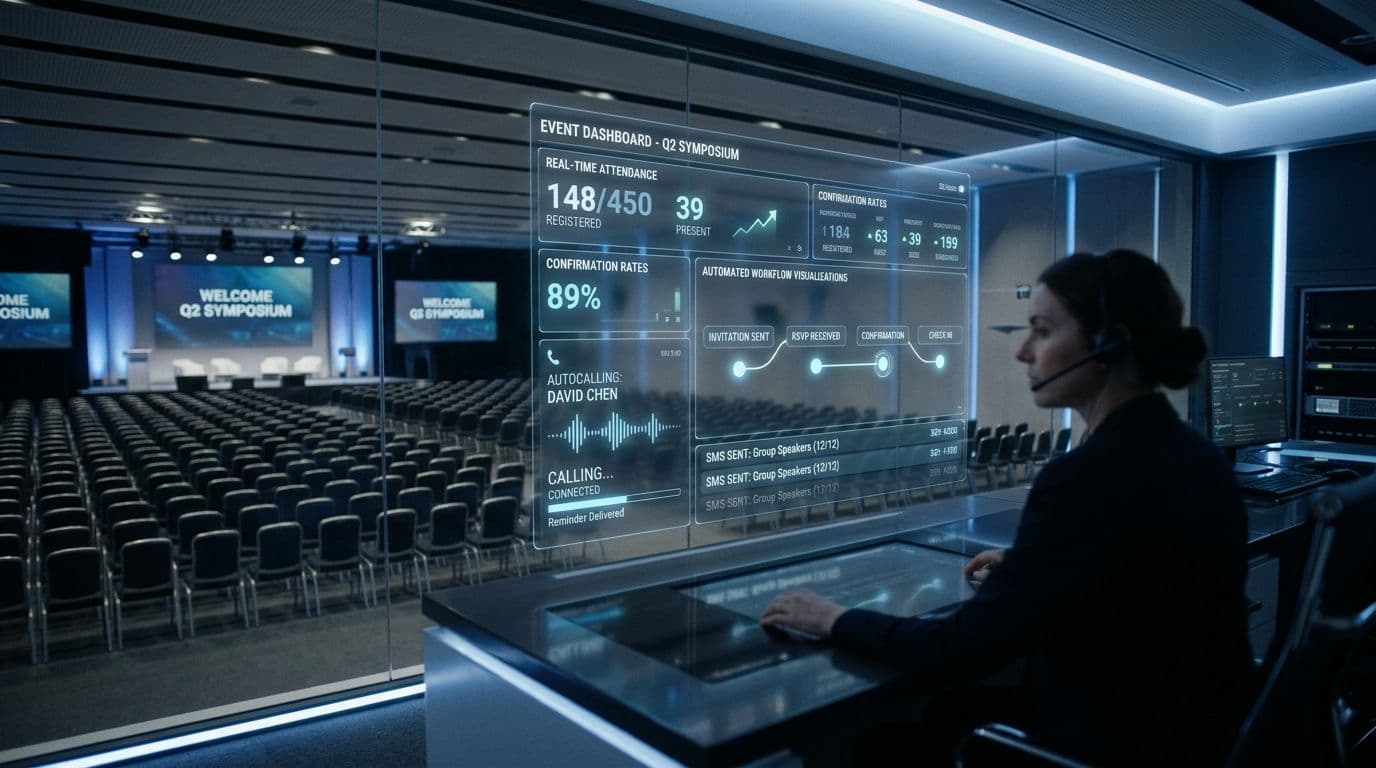
The AI conversation in event management has shifted. Six months ago, teams talked about "AI assistants" that could suggest session times or draft reminder emails. Today, they're deploying autonomous systems that make confirmation calls, resolve logistics questions, and update attendance forecasts—without human intervention.
This isn't incremental improvement. It's a categorical shift from assistive AI to agentic AI. And event teams that understand the difference are building competitive advantages that compound with every event they run.
What Actually Changed
The terminology matters less than the capability shift. But here's the distinction that's reshaping how events operate:
Assistive AI helps humans work faster. It suggests text, flags issues, surfaces insights. The human still makes decisions and executes actions. Think: email draft suggestions, sentiment analysis on attendee feedback, recommended follow-up times.
Agentic AI executes workflows autonomously. It understands objectives, makes decisions within defined parameters, takes actions, evaluates outcomes, and adapts without constant human oversight. Think: making 500 confirmation calls, answering logistics questions in real-time, updating CRM records based on conversation outcomes.
Gartner projects that 40% of enterprise applications will include task-specific AI agents by end of 2026, up from less than 5% in 2025. For event management—an industry built on high-volume, time-sensitive communication—this shift has immediate operational implications.
Why Event Teams Are Moving Beyond Co-Pilots
Assistive AI has value. But it hits a ceiling fast when applied to event operations. Here's why:
Events Require Action, Not Suggestions
When 500 registrants need attendance confirmation 48 hours before your conference, you don't need AI to suggest what to say. You need AI that makes the calls, handles questions, resolves concerns, and updates your dashboard with real-time confirmation status.
The value isn't in drafting better reminder emails. It's in eliminating the gap between "we should confirm attendance" and "attendance is confirmed." As we explored in our analysis of where events lose momentum, that gap is where most events fail—not in planning, but in execution.
Humans Can't Scale to Event Volume
A three-person event team can manually call maybe 75 registrants in a day if they do nothing else. But most events have 200-2,000 registrants, and your team has a dozen other critical tasks competing for attention.
Assistive AI might help you draft better call scripts or prioritize who to call first. But it doesn't solve the fundamental capacity problem. Agentic AI does—by handling the volume autonomously while your team focuses on complex, high-value work.
Timing Windows Are Non-Negotiable
Event communication is time-sensitive. The optimal moment to confirm attendance is 48-72 hours before the event. Miss that window, and your confirmation rate drops 30-40%.
Assistive AI that helps you work 20% faster doesn't help if you still can't reach everyone in the critical window. Agentic AI that can engage 1,000 registrants simultaneously in 2 hours does.
What Agentic AI Actually Does in Event Operations
The shift from co-pilot to autopilot isn't about eliminating human oversight. It's about moving humans from execution to governance.
Real Agentic AI Capabilities (2026)
Modern agentic systems in event management can:
Execute complete workflows autonomously
- Initiate proactive outreach to every registrant at optimal times
- Handle conversational inquiries across voice, SMS, and email
- Answer logistics questions by accessing venue data, agenda details, and policy information
- Escalate complex cases to humans with full conversation context
- Update CRM and event management platforms in real-time
Learn and adapt from outcomes
- Identify which communication approaches generate highest confirmation rates
- Recognize patterns in why people don't confirm (logistics uncertainty, schedule conflicts, etc.)
- Adjust messaging based on what's working for different attendee segments
- Surface insights about common questions that indicate systemic communication gaps
Operate within defined boundaries
- Know when to escalate to humans (policy exceptions, VIP attendees, complex requests)
- Follow brand voice and compliance requirements
- Respect communication preferences and channel constraints
- Maintain audit trails of every decision and action
This isn't science fiction. According to industry research, 95% of event professionals expect AI use to increase in 2026, with agentic implementations leading adoption in high-volume communication workflows.
The Economics of Autonomous Execution
The business case for agentic AI isn't about reducing headcount. It's about enabling your team to focus on strategic work that actually requires human judgment.
Capacity Transformation
Consider a typical 500-person conference:
Pre-agentic model
- 40 hours spent on manual confirmation calls (reaching ~150 people)
- 30 hours answering pre-event logistics emails
- 15 hours updating registration and attendance tracking
- Total: 85 staff hours on high-volume, repetitive work
Agentic model
- 2 hours spent configuring and monitoring AI system
- 5 hours handling escalated complex cases
- 3 hours analyzing insights and adjusting strategy
- Total: 10 staff hours, with 75 hours freed for strategic work
That 75-hour delta doesn't just save money. It enables your team to focus on sponsor relationships, programming quality, and attendee experience optimization—work that directly impacts event success but consistently gets deprioritized when teams are buried in operational volume.
Predictability Premium
Beyond capacity, agentic AI creates operational predictability that assistive AI can't match.
When you can proactively engage every registrant, you get real-time data on actual attendance likelihood. You know—days before the event—whether 500 registrations means 450 attendees or 350. That predictability changes everything about operational planning.
As we detailed in our post on calculating the real cost of no-shows, the financial impact of attendance unpredictability ranges from $35,000-$65,000 per mid-sized event. Agentic systems that improve forecast accuracy by even 15-20% pay for themselves immediately.
Why Most "AI" in Events Isn't Agentic Yet
Despite the buzzwords, most event AI implementations in early 2026 remain assistive, not agentic. Here's why:
Agent Washing is Rampant
Gartner estimates only about 130 of thousands of agentic AI vendors are legitimate. Many vendors rebrand chatbots and email automation as "agentic" without meaningful autonomous capability.
Real agentic AI requires:
- Multi-step reasoning and decision-making capability
- Tool use (accessing systems, updating records, initiating actions)
- Persistent memory across interactions
- Goal-directed behavior with outcome evaluation
- Graceful handling of ambiguous or unexpected situations
If the system can't independently execute a complete workflow from start to finish, it's assistive, not agentic—regardless of marketing claims.
Implementation Complexity
Building truly agentic systems is harder than deploying assistive AI. It requires:
- Deep integration with event management platforms and CRM systems
- Comprehensive knowledge bases covering venue details, policies, and logistics
- Sophisticated conversation handling across multiple channels
- Clear escalation rules and human-in-the-loop governance
- Continuous monitoring and refinement based on real-world performance
This complexity is why over 40% of agentic AI projects will be canceled by end of 2027—most teams underestimate what's required to move from demo to production.
As we explored in our analysis of why AI automations fail after 30 days, the gap between pilot success and production reliability is where most implementations break down.
How to Identify If You Need Agentic vs. Assistive AI
Not every event team needs autonomous AI. Here's how to assess:
You Need Assistive AI If:
- Your events are small (under 100 attendees)
- You have adequate team capacity for manual execution
- Your workflows are simple and low-volume
- You primarily need help with content generation or analysis
- Human judgment is required for most decisions
Assistive AI delivers value by: Making your existing team more efficient at tasks they're already executing manually.
You Need Agentic AI If:
- Your events have 200+ attendees
- High-volume, repetitive workflows consume significant team time
- Time-sensitive communication windows create operational bottlenecks
- You struggle with the registration-to-attendance gap
- You need to scale communication without proportionally scaling team size
Agentic AI delivers value by: Executing entire workflows autonomously so your team can focus on strategic, high-value work.
The Implementation Reality Check
Moving to agentic AI isn't about deploying a tool. It's about redesigning workflows around autonomous execution.
What Success Actually Requires:
1. Clear workflow definition
Identify specific, bounded processes where autonomous execution adds value. "Improve attendee engagement" is too vague. "Confirm attendance for all registered attendees 48 hours before the event" is specific enough to operationalize.
2. Robust system integration
Agentic AI needs access to your event management platform, CRM, communication channels, and knowledge bases. Integration quality determines whether the system can actually execute workflows or just suggest actions.
3. Explicit governance rules
Define when the AI should act autonomously versus escalate to humans. What decisions can it make? What actions require approval? How do you audit outcomes?
4. Continuous refinement
Agentic systems get better through iteration. You need processes to review performance, identify failure patterns, update knowledge bases, and adjust decision logic based on real-world results.
The Right Starting Point
Teams that succeed with agentic AI start narrow and expand gradually:
- Phase 1: Automate one high-volume, time-critical workflow (e.g., attendance confirmation)
- Phase 2: Expand to adjacent workflows once you've proven value (e.g., logistics Q&A)
- Phase 3: Scale to comprehensive event communication management
This staged approach builds organizational muscle for operating autonomous systems while delivering incremental value that funds further investment.
What This Means for Your Next Event
The shift from assistive to agentic AI in events isn't coming—it's here. McKinsey projects agentic AI could add $2.6-$4.4 trillion in annual economic value across industries by enabling autonomous execution of workflows that previously required human involvement.
For event teams, the question isn't whether to adopt agentic AI. It's whether you'll build that capability proactively or be forced to catch up when competitors are already operating at scale you can't match manually.
The teams that move first will learn faster, refine their approaches more thoroughly, and build operational muscle that's hard to replicate. The teams that wait will eventually adopt out of necessity—but they'll be playing catch-up with competitors who've been optimizing agentic systems for years.
Moving Forward
Co-pilots are valuable. They make you faster, smarter, more efficient at what you're already doing. But autopilots change what's possible—they enable scale, consistency, and speed that manual execution can't match.
Event management is moving from co-pilot to autopilot faster than most realize. The question is whether your team will be leading that transition or scrambling to keep up.
Because in the end, event success isn't just about better planning or smarter strategy. It's about execution—the ability to engage every registrant, confirm every attendance, answer every question, and close every operational gap between intention and reality.
That's where agentic AI stops being interesting technology and starts being operational infrastructure. And operational infrastructure determines who wins.
About KNVI Labs
KNVI Labs builds agentic AI systems that make event attendance predictable. Our focus is on autonomous execution of high-volume, time-sensitive workflows—where most events lose value but few teams have capacity to address manually.
Experience Agentic AI in Action
See how KATHN moves beyond suggestions to autonomous attendance confirmation—executing complete workflows at scale.
Frequently Asked Questions
What is agentic AI for event management?
Agentic AI for event management refers to AI systems that autonomously execute event workflows — such as making confirmation calls to registered attendees, answering logistics questions, updating CRM records, and escalating issues to human staff — without requiring a person to initiate each action. Unlike assistive AI that suggests actions for humans to take, agentic AI completes those actions independently based on defined goals and real-time context.
How is agentic AI different from a regular AI chatbot for events?
A regular AI chatbot for events is reactive — it responds when an attendee asks a question. Agentic AI is proactive — it identifies which registrants need confirmation, initiates outreach at the optimal timing window (48–72 hours before the event), handles the full conversation, and updates your systems automatically. The key difference is that agentic AI acts on its own initiative, not just on attendee initiative.
Can agentic AI replace human event coordinators?
No — agentic AI is designed to handle high-volume, repeatable tasks like confirmation calls and logistics FAQs, freeing human coordinators to focus on strategic decisions, complex problem-solving, and relationship-building. In practice, teams using agentic AI see operational hours drop by 80%+ on routine confirmation work, which means they redirect those hours to higher-value activities rather than reducing headcount.
What ROI can event teams expect from agentic AI?
Based on early deployments, event teams using agentic AI for confirmation workflows see an 8–12% improvement in actual attendance rates and reduce staff hours on confirmation tasks by up to 88%. For a 500-person paid conference, a 10% attendance improvement at $300 average revenue per attendee means $15,000+ in recovered revenue per event — typically exceeding the cost of an AI system within the first deployment.
How long does it take to deploy an agentic AI system for event management?
Implementation timelines vary by system complexity and integration requirements, but purpose-built agentic event AI systems like KATHN by KNVI Labs are designed to deploy within days via a structured pilot program. The key factor is not deployment speed but integration quality — systems connected to your CRM, registration platform, and communication channels from day one outperform standalone tools significantly in production.
Hemal Shah is the Co-Founder of KNVI Labs, where Hemal builds AI systems that help event organizers turn registrations into confirmed attendance. Hemal writes about voice AI, event automation, and the operational patterns behind attendance optimization.
Run one event with KATHN. See the difference.
Voice, SMS, and chat agents across your full event lifecycle — pre-event, day-of, and post-event. Pilots launch in 5 days with zero technical lift.