21 Event Engagement Ideas That Actually Work in 2026 (For Conferences, Expos & Corporate Events)
TL;DR — Key Takeaways
- 1Most event engagement fails for the same reason: it's bolted on instead of designed in. The strongest engagement ideas start at registration and run through 72-hour post-event follow-up, not just during sessions
- 2Pre-event engagement (voice confirmation calls, AI chat for questions, personalised SMS reminders) is the highest-leverage stage — it lifts show-up rates 20-30%+ before the event even starts
- 3Day-of engagement that actually works: live polling tied to speaker prompts, structured networking (not 'mingle freely'), gamified booth visits, real-time Q&A with moderator-curated answers
- 4Post-event engagement is where most ROI is lost: 72-hour follow-up sequences (thank-you → impact moment → ask) consistently outperform week-later email blasts by 3-5x
- 5AI is changing the engagement game — voice calls reach 85-90% of registrants (vs ~20% email open rates), and AI chat agents handle the day-of question spike that overwhelms most ops teams
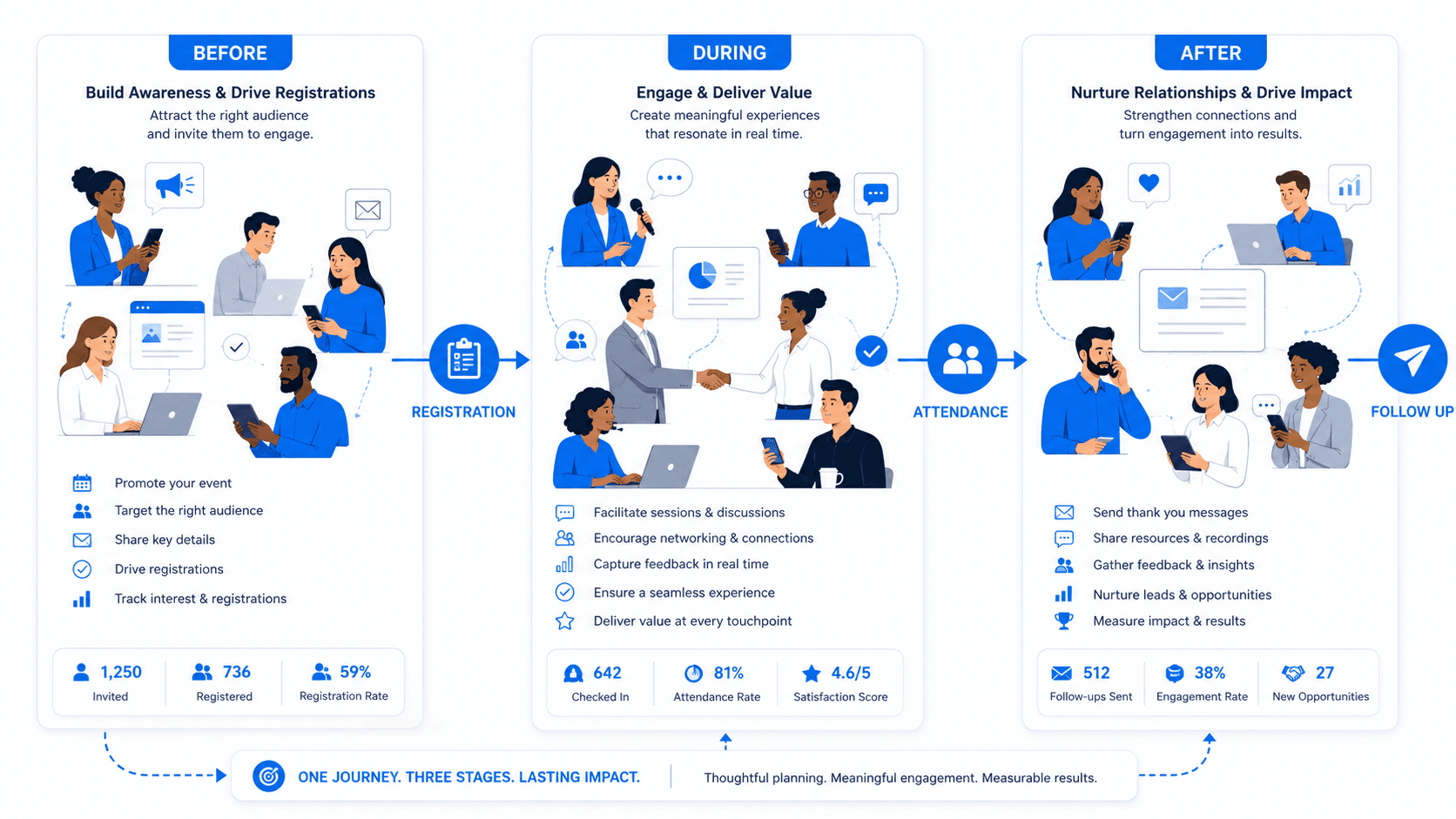
There are roughly a thousand articles on the internet titled some variation of "best event engagement ideas." Most of them are lists of standalone tactics — photo booths, scavenger hunts, ice-breakers — disconnected from the event's actual goals.
This is a different list. It's organised by stage (pre-event, day-of, post-event) and weighted by what actually moves the numbers: attendance, NPS, sponsor ROI, and re-registration. Written for event professionals running conferences, expos, and corporate events in 2026.
Why most event engagement fails
Engagement is not a session tactic. It's a lifecycle.
The teams that win on engagement design touchpoints across the entire arc — from registration confirmation, through pre-event communication, into day-of experience, and through 72-hour post-event follow-up. Standalone activities at the event itself (photo booths, swag bags) add polish, not engagement.
The three stages where engagement actually moves the needle:
- Pre-event — confirming attendance, priming for sessions, surfacing logistics
- Day-of — connecting sessions to actions, structured networking, real-time Q&A
- Post-event — converting attendance into next year's registration and referrals
Most events over-invest in stage 2 and under-invest in stages 1 and 3. The ideas below are weighted accordingly.
Pre-event engagement (ideas 1-7): The highest-leverage stage
1. Voice confirmation calls 7-14 days out
The single highest-impact engagement tactic that almost nobody does at scale. AI voice agents (or human callers for smaller events) confirm attendance, surface logistics concerns, and create a personal touchpoint. Voice reaches 85-90% of registrants vs ~20% email open rates. The teams running this typically lift show-up rates 20-30%.
2. Personalised logistics packet within minutes of registration
A logistics-rich email or SMS sent automatically: venue map link, parking/transit info, recommended arrival window, dress code, calendar invite, and a one-click "questions?" link to AI chat. Sets the tone that the event team has its act together.
3. Session preference micro-commitment
3-5 days after registration, ask one short question: "Which sessions are you most interested in?" or "What's the one thing you want from this event?" The answer is operationally useful and the act of answering creates investment.
4. Pre-event AI chat agent on the event website
Most attendees have 2-3 logistics questions in the final week. An AI chat trained on the event's agenda, venue, speakers, and policies answers them instantly. Reduces day-of confusion and surfaces last-minute concerns to the event team before they become no-shows.
5. Speaker preview snippets via SMS or email
A 90-second video from a keynote speaker, sent 5 days before the event. Primes attendees for the session and creates anticipation. Particularly effective for industry-name speakers.
6. Pre-event networking matchmaking
Tools like Brella, Grip, or built-in features of platforms like Whova let attendees match with peers before they arrive. Pre-event meetings get booked, and attendees show up with a reason to be there beyond the sessions.
7. Morning-of activation message
A short SMS at 7-8 AM the day of the event: event name, time, one logistics tip, one agenda highlight, and one direct link. Activates the registrants who were 60% committed to actually walking through the door.
Day-of engagement (ideas 8-15): Designed in, not bolted on
8. Live polling tied to speaker prompts
Standalone live polling rarely works because nobody answers. Polling that's part of the speaker's narrative ("Show of hands — and now, the room view") creates real participation. Slido, Mentimeter, or the built-in event app polling all work.
9. AI chat agent for day-of logistics
The day-of inquiry spike is brutal. "Where's the keynote?" "What time is the closing party?" "Is the AI track recorded?" AI chat trained on the agenda handles tier-1 questions automatically. Frees the ops team for real escalations.
10. Structured networking sessions
"Mingle freely" generates 5 conversations and an awkward room. Structured 1-on-1 speed networking by interest tag (15 minutes × 4 partners) generates 20+ meaningful conversations and noticeably higher NPS scores.
11. Gamified booth visit cards (for expos)
Cards or app-based stamp collection at expos. Visit 8 of 12 sponsor booths, and get entered into a draw. Sponsors get measurable foot traffic. Attendees get a reason to circulate.
12. Real-time Q&A with moderator curation
Open Q&A devolves. Open submission with a moderator curating and asking the best questions out loud — that's where the gold comes out. Slido and Pigeonhole handle this well.
13. Hands-on workshop tracks (not lecture rooms)
If your event has multiple session types, mark one explicitly as "hands-on" — laptops open, exercises, peer feedback. Attendees increasingly skip lecture-style sessions in favour of work sessions.
14. Live whiteboarding sessions
Tools like Miro and FigJam are used on a projector with audience input. Works particularly well for strategy sessions, brainstorms, and applied content.
15. Lunch table topics
Assigned tables by topic at lunch. Removes the awkward "where do I sit?" moment and creates intentional conversations. Display topic placards on each table.
Post-event engagement (ideas 16-21): Where most ROI is lost
16. 4-hour thank-you with a specific reference
Send within 4 hours of the event closing. Reference something specific (a session, a speaker moment, a theme). Generic "thanks for attending" emails read as templated. Specific thank-yous create real engagement.
17. 24-hour feedback collection
NPS + 1-2 open-text questions. 24 hours post-event is the optimal window — experience is fresh, attention hasn't moved on. Response rates at 24 hours run 3-5x higher than week-later surveys.
18. 72-hour re-engagement nudge
One clear action: early bird for next year, referral link, session recording access (attendees only), or a sponsor offer while the relationship is warm. Most events stop communicating after the survey; the teams that follow through here see noticeably higher re-registration rates year-over-year.
19. Personalised session recap
A short summary of the sessions the attendee actually attended (or expressed interest in pre-event). Reinforces the value they got and gives them shareable content for their team.
20. Connection list delivery
Send each attendee a list of the people they met or connected with at the event. Even a CSV. The connections list is the asset that compounds — it's what attendees actually use months later.
21. 30-day check-in (the one nobody does)
A month after the event, a single message: "We're back to building. What did you actually do with what you learned at [event]?" The response rate is low, but the responses are gold — they're the case studies that fund next year's marketing.
The data behind these tactics
A few patterns worth knowing as you choose where to invest:
- Email open rates for event reminders average ~20% across the industry. Most of your registrants never see your communications.
- SMS open rates are 98% with response times under 90 seconds. SMS is the most underused engagement channel in events.
- Voice contact rates for AI voice campaigns regularly hit 85-90% — meaningfully higher than email but not yet adopted broadly.
- Day-of inquiry volume spikes 200-400% on event morning. Most ops teams aren't staffed for this, and engagement suffers as a result.
- Post-event email response rates drop sharply after 72 hours. The teams that close the loop in the 72-hour window pull dramatically ahead.
For the full breakdown of which stage to invest in first, see our guide to event attendee lifecycle management.
How AI is changing event engagement in 2026
A note for 2026 planning: AI is moving event engagement from "do more activities" to "design the whole lifecycle deliberately."
- AI voice agents handle the pre-event confirmation calls that human teams can't make at scale
- AI chat agents answer day-of questions that overwhelm ops teams
- AI-powered personalisation sends each attendee the version of the recap most relevant to them
- AI follow-up sequences handle the 72-hour window automatically
This is the underlying shift. Most of the engagement ideas above are 2-3x more effective when an AI layer runs the communication side, leaving the event team free to focus on programming and on-site experience.
For a deeper look at how AI plugs into event communication specifically, see Kairos — our AI communication platform for events, and the 10 proven ways to reduce event no-shows.
What to do with this list
Don't try to do all 21.
Pick three based on your current event's biggest gap:
- If show-up rates are weak: pre-event voice + SMS + morning-of activation (#1, #2, #7)
- If day-of engagement is flat: structured networking + live polling + AI chat for queries (#8, #9, #10)
- If post-event re-registration is weak: 4-hour thank-you + 24-hour feedback + 72-hour nudge (#16, #17, #18)
Three deliberate tactics across the lifecycle will outperform 21 standalone activities every time.
Related reading: The Complete Guide to Event Attendee Lifecycle Management · 10 Proven Ways to Reduce Event No-Shows · Measuring What Matters: From Registration to Real Attendance · Where Events Lose Momentum
Frequently Asked Questions
What is the most effective event engagement idea?
The single highest-leverage engagement tactic is pre-event voice confirmation calls. They confirm attendance at 85-90% contact rates (vs ~20% email open rates), surface logistics concerns before they become no-shows, and create a personal touchpoint that primes attendees for stronger in-event engagement. Combined with day-of AI chat for inbound questions and a structured 72-hour post-event sequence, this is the engagement playbook that consistently moves attendance, NPS, and re-registration numbers.
How do you engage attendees at a conference?
Conference engagement works in three stages. Pre-event: confirm attendance via voice + SMS, send a personalised logistics packet, and ask one micro-commitment question (session preferences, dietary, networking interest). Day-of: structured networking (not 'mingle freely'), live polling tied to speaker content, gamified track participation, real-time Q&A. Post-event: 4-hour thank-you, 24-hour feedback ask, 72-hour re-engagement nudge. The teams that engage well don't add gimmicks — they design the full lifecycle deliberately.
What are some interactive event ideas?
Effective interactive event ideas include: live polling integrated with speaker presentations (not standalone), pre-arrival app challenges that prime attendees for sessions, gamified booth visit cards at expos, structured networking matchmaking (LinkedIn-style speed networking by interest tag), live Q&A with moderator-curated answers, hands-on workshop tracks, and AI-powered chat agents that answer day-of logistics questions instantly. The pattern: interactive ideas that connect to the event's actual content outperform standalone activities.
How do you engage attendees before the event?
Pre-event engagement is the highest-ROI stage and the most often skipped. The teams that do it well run a multi-touch sequence: immediate logistics packet within minutes of registration (venue, parking, calendar invite), voice confirmation call 7 days out, SMS reminder 48 hours and morning-of. Adding an AI chat agent on the event website handles the inbound questions that pile up in the final week. This sequence typically lifts show-up rates by 20-30%.
How long should you wait to follow up after an event?
The 72-hour window after an event is where most engagement is lost. The strongest pattern: send a thank-you touchpoint within 4 hours (reference something specific from the event), a feedback or insight ask at 24 hours (response rates 3-5x higher than week-later surveys), and a re-engagement or next-event nudge at 72 hours. Past 72 hours, attendee memory of the event begins to decay measurably and follow-up effectiveness drops sharply.
Hemal Shah is the Co-Founder of KNVI Labs. Hemal works alongside event organizers, PCOs, and event-tech companies on AI strategy, and co-built Kairos — the AI communication platform that runs voice, chat, and SMS across the attendee lifecycle. Hemal writes about event operations, AI for events, and the patterns behind events that fill the room.
Run one event with Kairos. See the difference.
Voice, SMS, and chat agents across your full event lifecycle — pre-event, day-of, and post-event. Pilots launch in 5 days with zero technical lift.