Event Management Certifications: The Complete 2026 Guide (CMP, CSEP, DES, and 9 Others Compared)
TL;DR — Key Takeaways
- 1The CMP (Certified Meeting Professional) is the most recognised event certification in North America — administered by the Events Industry Council, ~$700-$925 to take, and the closest thing to an industry-standard credential
- 2The CSEP (Certified Special Events Professional) is the right fit for event designers and producers running weddings, brand activations, and experiential events — administered by ILEA
- 3The DES (Digital Event Strategist) is the only major cert focused on virtual and hybrid events — administered by PCMA, ~$795-$1,095, modular online learning
- 4Most certifications require 3+ years of event experience. If you're early-career, start with a university certificate (NYU, GW, Cornell) and pursue CMP after year three
- 5Certifications correlate with salary lift (CMP holders report ~$8K-15K higher median than non-CMP peers per industry surveys) but the bigger gain is the network and continuing-education access
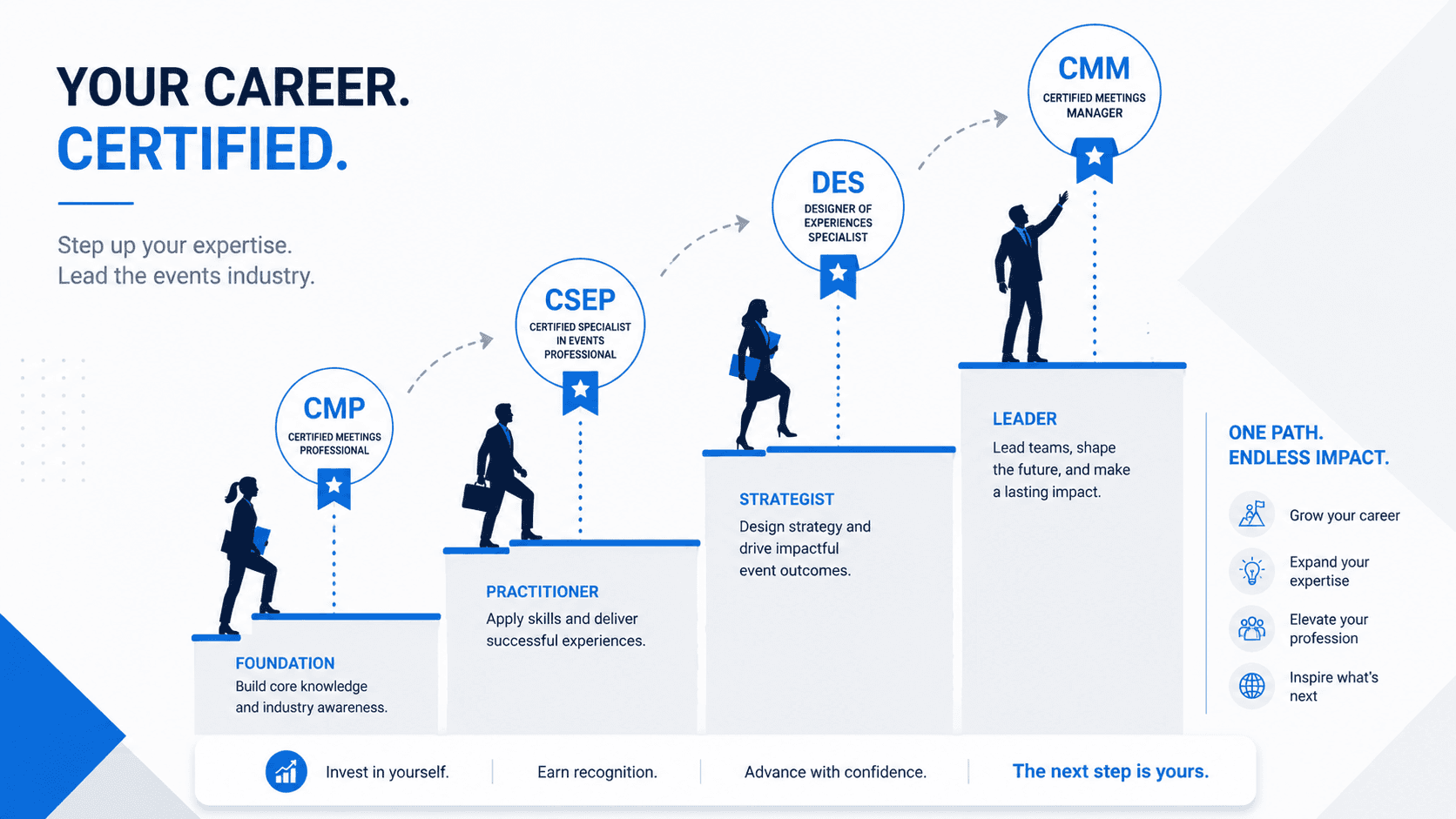
If you're working in events and asking which certification to pursue, you're in good company — and you'll get a different answer from every senior planner you ask.
The honest reality: there are ~12 meaningful event management certifications in North America, they target different segments of the industry, and the credibility gap between the top 2-3 and the rest is real. This guide breaks down what each one is, who it's for, what it costs, and which one moves a career.
Written for working event professionals in the US and Canada in 2026.
The top 3 certifications you've actually heard of
These are the certs that show up in job descriptions, RFPs, and venue selection criteria. If you're going to invest in one cert, it's almost certainly going to be one of these.
1. CMP — Certified Meeting Professional
Administered by: Events Industry Council (EIC) Cost: $700 member / $925 non-member (application + exam) Requirements: 36 months full-time event experience + 25 hours of continuing education + passing the exam Best for: Corporate meeting planners, conference producers, association event teams, hotel sales and CVB professionals
The CMP is the closest thing the industry has to a standard credential. It's referenced in job postings across corporate event roles, association management roles, and hospitality sales. The exam covers nine domains: strategic planning, project management, financial management, human resources, stakeholder management, meeting design, site management, marketing, and professional practice.
The CMP credential needs to be renewed every five years through continuing education. The renewal cycle is what makes the certification valuable long-term — it pulls credential holders into ongoing learning and industry community.
Verdict: If you're going to get one event cert and plan to stay in business events, get CMP.
2. CSEP — Certified Special Events Professional
Administered by: International Live Events Association (ILEA) Cost: ~$400 application + $325 exam (member rates lower) Requirements: 3 years full-time special events experience + portfolio submission + exam Best for: Event designers, producers, wedding planners, brand activation specialists, experiential and entertainment event professionals
CSEP is to the special events world what CMP is to meetings. The application includes a portfolio review where candidates document their work on real events — this is a meaningful credibility signal because it requires demonstrated production capability, not just exam performance.
Verdict: If your career is in event design, production, or experiential — CSEP over CMP.
3. DES — Digital Event Strategist
Administered by: PCMA (Professional Convention Management Association) Cost: $795 member / $1,095 non-member Requirements: No minimum experience; self-paced online programme Best for: Professionals running virtual events, hybrid programmes, or pivoting into digital event strategy
DES is the youngest of the major certifications and the most accessible — there's no experience requirement, and the entire programme is self-paced online. The curriculum covers virtual event strategy, technology selection, content design, marketing, and post-event measurement. The cert has gained meaningful recognition since the 2020 shift to virtual events, and remains relevant as hybrid programmes continue to grow.
Verdict: If you run or are pivoting toward virtual or hybrid events, DES is the only cert that fully speaks to that work.
The next tier — credible, more specific
These certifications have real recognition in their specific niches but smaller audiences than the top 3.
4. CMM — Certificate in Meeting Management
Administered by: MPI (Meeting Professionals International) Cost: ~$4,000-$5,000 Requirements: 7+ years of strategic meeting management experience Best for: Senior event leaders, directors, and VP-level event roles
CMM is positioned at the executive level. The curriculum focuses on business strategy, financial management, and leadership rather than operational meeting planning. It's a meaningfully bigger investment than CMP but credentials senior leadership in larger event programmes.
5. CGMP — Certified Government Meeting Professional
Administered by: Society of Government Meeting Professionals (SGMP) Cost: ~$500 + SGMP membership Requirements: Active SGMP member + government meeting planning experience + classroom course Best for: Federal, state, and municipal event planners — anyone working in government event compliance
CGMP is a niche but valuable. Government event planning has specific compliance requirements (per diem rules, contracting regulations, and FAR compliance) that CGMP directly addresses. If your work touches federal contracts or government clients, this is the cert.
6. CEM — Certified in Exhibition Management
Administered by: IAEE (International Association of Exhibitions and Events) Cost: ~$2,000-$3,000 across all required courses Requirements: 3+ years exhibition or trade show experience + completing 9 required courses Best for: Trade show organisers, exhibition managers, booth sales and management professionals
CEM is the specialist credential for the trade show world. The curriculum covers exhibition operations, sales, sponsorship, attendance acquisition, and floor management. If you're running an expo or working in exhibition sales, CEM is the right credential.
Specialised and emerging certifications
7. CTSM — Certified Trade Show Marketer
For exhibitors and trade show marketers (rather than organisers). Administered by Northern Illinois University.
8. CMEP — Certified Meeting and Event Planner
Administered by Saint Louis University. More accessible than CMP but with less industry recognition.
9. VEMM — Virtual Event & Meeting Manager
A micro-credential focused on virtual event production. Multiple providers; recognition varies.
10. Sustainable Event Professional (SEP)
Administered by EIC. Focused on sustainability and environmental responsibility in event production. Gaining recognition as ESG-aware event programming grows.
11. CSE — Certified Sponsorship Executive
For sponsorship sales and management specialists. Administered by IEG.
12. Hybrid Event Specialist credentials
Multiple commercial training providers offer hybrid-focused micro-credentials. Recognition varies — useful for skill-building, less useful as a CV signal.
University-based event management certificates
For early-career professionals or career-changers, a university certificate is often a better starting point than a professional certification.
NYU SPS — Event Management Certificate ~$2,500. 6-9 months, online or in-person. Strong industry recognition in the New York and East Coast event scene.
George Washington University — Event Management Certificate ~$5,000-$8,000. Strong programme with a deep alumni network. Recognised across corporate and government event roles in DC, Maryland, and Virginia markets.
Cornell — Hospitality and Event Management $2,000-$10,000+ depending on track. Top-tier brand. Heavy hospitality focus — best fit if your career is in venue management, hotel events, or destination management.
MGM Resorts University, San Diego State, and NYU Stern also offer event management programmes with varying focuses.
How to choose: a 3-step framework
Step 1: Where are you in your career?
- 0-2 years: University certificate (NYU, GW, Cornell). Build experience first.
- 2-5 years: First professional cert — CMP if you're in business events, CSEP if you're in design/production.
- 5+ years: Add specialisation — DES if you're moving to hybrid, CMM if you're moving to leadership, CGMP if you're in government work.
Step 2: What kind of events do you run?
- Corporate meetings, conferences, association events → CMP
- Weddings, brand activations, experiential events → CSEP
- Virtual or hybrid programmes → DES
- Trade shows, expos → CEM
- Government and federal events → CGMP
Step 3: What does your employer (or target employer) value?
- Check job postings for the senior roles you're aiming for. The certs that appear in those listings are the ones that move the hiring needle in your specific market and segment.
The honest take on certification ROI
Two things to keep in mind:
The salary lift is real but modest. Industry compensation surveys consistently show a positive correlation between certifications and pay — CMP holders typically report $8,000-$15,000 higher median salaries than equivalent non-CMP peers. Whether the cert causes the lift or simply correlates with the people who pursue it is hard to fully untangle.
The network and continuing education matter more than the credential itself. The CMP renewal cycle keeps holders connected to industry council events, benchmarking studies, and peer networks for the rest of their careers. That access is worth more than the three letters on a CV.
Where AI fits in the event career stack
A note for 2026 and beyond: every major event certification now references AI in some form. CMP added AI applications to its strategic planning domain. PCMA's DES programme weaves AI tools into the digital event production curriculum. Working knowledge of AI for events — pre-event communication, attendee data, real-time coordination — is rapidly becoming table stakes.
For practical AI implementation alongside any of these certifications, see our complete guide to event attendee lifecycle management and the 10 proven ways to reduce event no-shows. These tools and frameworks complement the strategic knowledge that certifications cover.
Quick reference table
- Certification: CMP · Body: EIC · Cost: $700-$925 · Experience required: 36 mo + 25 CE hrs · Best for: Business meetings & corporate events
- Certification: CSEP · Body: ILEA · Cost: ~$725 + portfolio · Experience required: 3 yrs + portfolio · Best for: Special events, design, production
- Certification: DES · Body: PCMA · Cost: $795-$1,095 · Experience required: None · Best for: Virtual & hybrid events
- Certification: CMM · Body: MPI · Cost: $4,000-$5,000 · Experience required: 7+ yrs · Best for: Senior leadership roles
- Certification: CGMP · Body: SGMP · Cost: ~$500 + membership · Experience required: Government events · Best for: Federal, state, municipal planners
- Certification: CEM · Body: IAEE · Cost: $2,000-$3,000 · Experience required: 3+ yrs · Best for: Exhibition and trade show pros
- Certification: CMEP · Body: Saint Louis U · Cost: ~$2,000 · Experience required: Varies · Best for: Mid-career planners
- Certification: Sustainable Event Pro · Body: EIC · Cost: ~$695 · Experience required: Working experience · Best for: ESG-focused programming
If you're sitting at the start of your event career and you've read this far — pick the university certificate that fits your geography (NYU East Coast, GW for DC/government work, Cornell for hospitality), spend 2-3 years building real production experience, then go after CMP. The rest of the certifications fit into a career arc that takes years to build.
And if you're already running events at scale and the question is what makes the next 5 years productive, the CMP renewal cycle plus one specialty cert (DES for virtual, CMM for leadership, CSEP for design) is the highest-leverage move.
The credential matters less than the network, the discipline of continuing education, and the actual events you run. Pick the one that gets you there.
Related reading: The Complete Guide to Event Attendee Lifecycle Management · 10 Proven Ways to Reduce Event No-Shows · Measuring What Matters: From Registration to Real Attendance
Frequently Asked Questions
Which event certification is the most recognised?
The CMP (Certified Meeting Professional) is widely regarded as the most-recognised certification in event management across North America. Administered by the Events Industry Council, it's referenced in job descriptions, RFPs, and CVB requirements far more often than any other event credential. CSEP and DES are highly respected in their specific niches (special events and digital events respectively), but CMP has the broadest recognition.
How much does it cost to get an event management certification?
Cost varies by certification. CMP runs $700-$925 for members and non-members. CSEP is around $400 for the application plus $325 for the exam. DES is $795 for PCMA members and $1,095 for non-members. CMM is in the $4,000-$5,000 range as it's an executive programme. University certificate programmes range from $2,500 (NYU SPS) to $10,000+ (GW, Cornell). Most certifications also require continuing education credits to maintain, adding $100-$500 per renewal cycle.
Do you need experience to get an event certification?
Most major certifications require working experience: CMP requires 36 months full-time event experience plus 25 hours of continuing education in the past 5 years. CSEP requires 3 years of full-time special events experience plus a portfolio review. CMM requires 7+ years of experience and is positioned as an executive credential. DES is more accessible — no minimum experience required, just completing the online programme. If you're new to the industry, start with a university certificate, build 2-3 years of experience, then pursue CMP.
Is the CMP certification worth it?
For working event professionals planning to stay in the field, yes. The CMP credential is referenced in roughly half of senior event role job postings in the US and Canada, and CMP holders report a meaningful salary premium versus non-CMP peers in industry compensation surveys. The harder-to-measure value is the network: CMP holders get access to industry council events, peer benchmarking, and continuing education that compounds over time. The investment of ~$700 plus 6-12 months of study is small relative to the career-long return.
Are there event certifications specifically for virtual or hybrid events?
The DES (Digital Event Strategist) from PCMA is the primary certification focused on virtual and hybrid events. It covers strategy, production, marketing, and measurement for virtual programmes. There's also the VEMM (Virtual Event & Meeting Manager) and the Hybrid Event Specialist micro-credentials, both available through commercial training providers. For a professional moving from in-person-only to a hybrid programme, DES is the standard.
What's the difference between CMP and CSEP?
CMP focuses on meetings, conferences, and business events — the operational and strategic side of event management. CSEP focuses on special events: weddings, brand activations, galas, experiential and entertainment events. CMP is broader and more recognised in corporate and conference environments; CSEP is more recognised in the event design, production, and hospitality side. Both can coexist on a CV; CMP is typically pursued first if your career is in corporate meetings.
Hemal Shah is the Co-Founder of KNVI Labs. Hemal works alongside PCOs and event-tech companies on AI strategy and implementation, and co-built Kairos — the AI communication platform for events. Hemal writes about event operations, AI for events, and the patterns behind events that actually run well.
Run one event with Kairos. See the difference.
Voice, SMS, and chat agents across your full event lifecycle — pre-event, day-of, and post-event. Pilots launch in 5 days with zero technical lift.