Why Your Post-Event Silence Is Killing Next Year's Attendance
TL;DR — Key Takeaways
- 1Events that run a structured post-event communication sequence see 2-3x higher repeat attendance than teams that go silent after the final session.
- 2The 72-hour window after your event closes is the highest-value communication window in the entire event cycle - and most teams miss it completely.
- 3Post-event silence costs you in three compounding ways: lower re-registration rates, referral decay, and sponsor ROI gaps that surface in next year's contract renewal.
- 4A three-stage automated sequence - Hour 0-4 thank-you, Hour 24 feedback request, Hour 72 re-engagement nudge - can run without adding team capacity.
- 5This is not a motivation problem. It is a systems problem. AI communication automation closes the follow-up gap without relying on post-event energy that is not there.
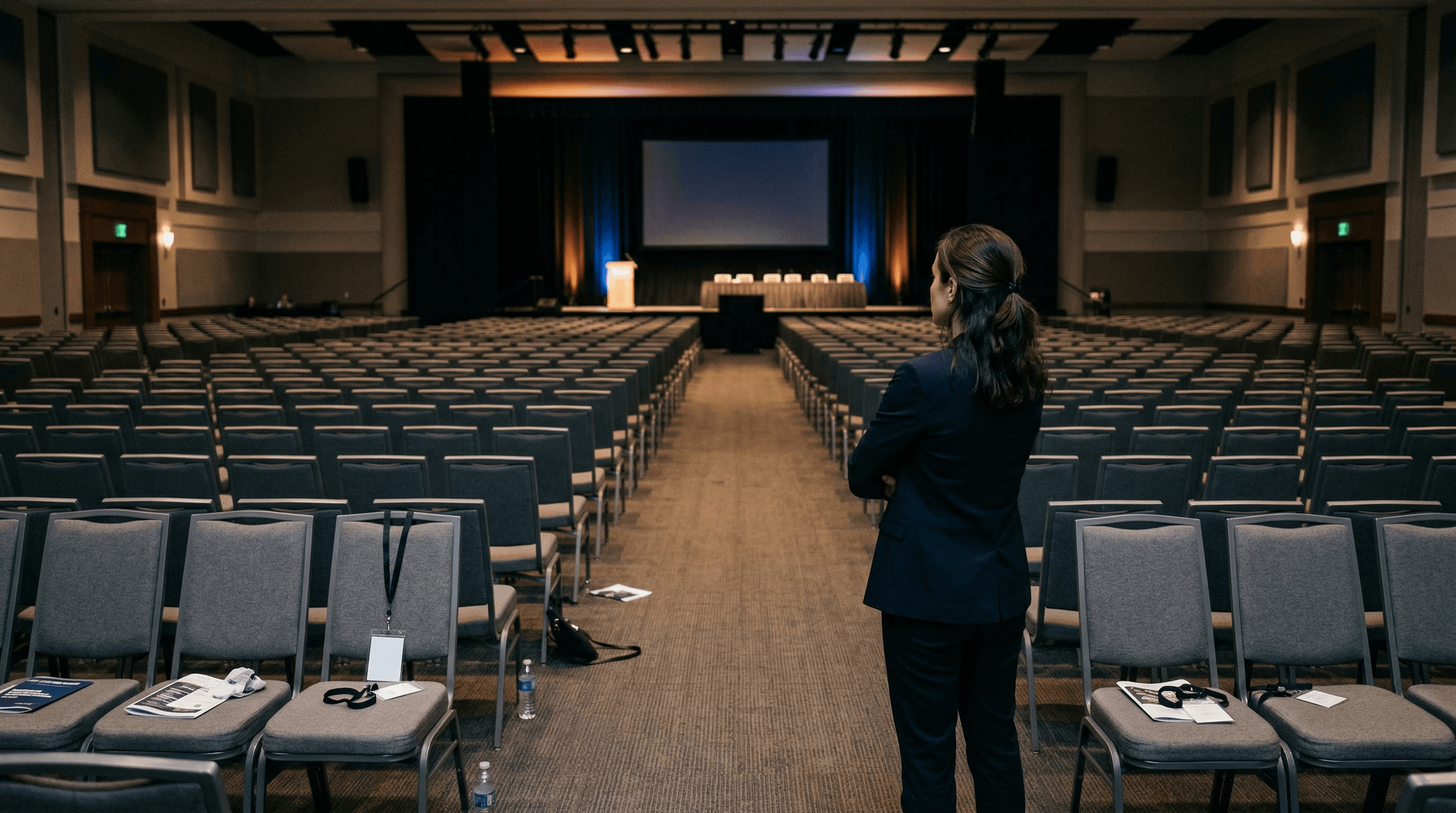
Most event teams pour everything into the weeks before the event. The confirmation calls go out. The SMS reminders are scheduled. The registration numbers climb. And then the event happens - and it goes well.
And then everyone goes quiet.
The team is exhausted. The venue is struck. The post-event tasks sit in a shared doc that nobody opens until the next planning cycle begins. The attendees - the people who showed up, connected with speakers, sat in sessions - hear nothing from you for days. Sometimes weeks.
That silence is one of the most expensive habits in event management. And almost nobody talks about it.
The moment the event ends, the clock starts ticking
Attendee memory is not durable. The emotional residue of an experience - the connections made, the sessions that mattered, the brand impressions formed - begins to fade within 48 to 72 hours without reinforcement. This is not a content quality problem. It is a communication timing problem.
An attendee who leaves your conference feeling energised and connected will, within three days of hearing nothing, begin to file that experience alongside every other busy week they have had this year. The motivation to re-register, refer a colleague, respond to a sponsor inquiry - all of it degrades without contact.
The best-run events in the US are not just winning on pre-event confirmation rates. As we covered in our breakdown of where events lose momentum, the gap between those teams and everyone else is growing - and most of it opens after the event ends, not before.
What attendees remember 48 hours later - and what they forget
Within 48 hours of an event, attendees retain the emotional tone of their experience more reliably than specific content. They remember how the event made them feel: informed, connected, inspired, overlooked, rushed. That emotional tone is what a well-timed post-event message anchors - and exactly what silence allows to drift.
By day three, absent any outreach, session names, speakers, and action items are competing with everything else in their calendar. By day seven, re-engagement from cold is significantly harder than it would have been from a warm 48-hour touchpoint.
The window is short. Most event teams miss it entirely.
The three things post-event silence costs you
The costs are not immediate - they show up in the next cycle, in the numbers that are harder to explain: flat re-registration, low referral rates, sponsor ROI that does not quite add up. Here is where the damage accumulates.
1. Repeat attendance and re-registration rates
Re-registration is not driven by the quality of this year's event alone. It is driven by the quality of the relationship between the event and its attendees - and relationships require contact. An attendee who receives a timely, personalised post-event message is significantly more likely to register for the next edition than one who hears nothing.
For annual conferences and recurring summits, the compounding effect is severe. A 10% drop in repeat attendance year-over-year, sustained across two or three cycles, hollows out your most valuable attendee segment: the people who already believe in your event.
2. Referral and word-of-mouth decay
An attendee who leaves your event and immediately hears from you - a thank-you that feels personal, a prompt to share their experience, an easy path to refer a colleague - is in the optimal state for referral. Their enthusiasm is fresh. The friction to act is low.
That window closes fast. Within a week, the same attendee has moved on. The referral that felt natural on day one requires effort by day ten. Post-event silence is the single biggest reason referral rates underperform relative to attendee satisfaction scores.
3. Sponsor ROI reporting gaps
Sponsors do not evaluate ROI based on lead count alone - they evaluate it based on what happened after the event. We have written about a 32% attendance gap that costs $47,000 or more per event. The same maths applies to post-event follow-through: teams that deliver structured post-event data to sponsors renew contracts at higher rates and at higher tiers.
Post-event communication is not just attendee relationship management. It is sponsor ROI delivery.
Why most event teams never close the loop
The absence of post-event communication is rarely a strategic choice. The problem is structural.
By the time the event ends, the team is depleted. The adrenaline has drained. Vendor invoices, internal retrospectives, and the decompression that follows any high-stakes live production absorb whatever capacity was left. The follow-up does not happen - not because it was deprioritised, but because no one had the energy or the system to run it.
The second problem is tooling. Most event teams rely on email platforms designed for campaigns, not for event-lifecycle communication. Sending a meaningful post-event sequence to 800 attendees - segmented by session attendance, personalised by engagement level, timed within 72 hours - is not a task that a standard marketing automation tool handles gracefully. It requires either significant manual effort or a communication layer that understands how events actually work.
The third problem is that nobody measures it. What does not get measured does not get fixed. This is exactly the pattern we described in our post on why AI automations fail after the first 30 days - the gap between good intentions and production-ready execution is where most follow-up systems collapse.
The follow-up gap is a systems problem, not a motivation problem. Teams that have post-event communication running automatically do not need to find energy they do not have after a major event. The sequence fires. Attendees hear from you. The window stays open.
What a 72-hour post-event AI communication sequence looks like
A structured post-event sequence does not require a large team or complex workflows. It requires three things: the right timing, the right channel, and the right message at each stage.
Hour 0-4: The thank-you touchpoint
The first post-event message should go out within four hours of the event's close - while the attendee is still in transit, still running on the energy of the day. This is not a survey. It is not a promotional message. It is an acknowledgment.
The most effective thank-you touchpoints are brief, specific, and human-sounding. They reference something real - the event name, a specific programme element, something that signals the message was not mass-generated. The goal is purely relational: interrupt the silence before it becomes the norm.
Done by AI, this touchpoint reaches hundreds of attendees simultaneously without feeling like a broadcast - voice AI can handle this at scale, reaching 500 attendees in the window a human team could reach 20. Done by SMS, it carries a link to session recordings or a personalised summary. The channel matters less than the timing.
Hour 24: The feedback window
Twenty-four hours after the event is the optimal window for feedback collection. The experience is fresh enough to be specific, settled enough to be reflective. A post-event feedback request at this point generates response rates significantly higher than the standard survey sent days later.
This is also the moment to capture sponsor-relevant data: net promoter scores, session ratings, early re-registration signals. As we explored in our guide to the metrics that actually predict event success, and supported by Bizzabo's 2026 event benchmark data, getting this data in the 24-hour window rather than the seven-day window gives event teams a material advantage in stakeholder reporting.
Hour 72: The re-engagement nudge
The 72-hour message is the one most teams never send - and arguably the most commercially valuable of the three. At this point, the attendee has returned to their normal work context. The event is recent but no longer immediate. A well-timed message here can:
- Prompt early re-registration for next year's event at an early-bird rate
- Invite the attendee to refer a colleague with a specific, frictionless mechanism
- Share resources - recordings, slides, speaker contacts - that extend the event's shelf life
- Introduce a sponsor partnership offer while the relationship is still warm
One ask, one clear action, delivered while the window is still open. Not a campaign. A continuation of the conversation that started at the event.
The teams already doing this - and the gap it is creating
Event teams in North America that have adopted structured post-event AI communication are not yet the majority. But the gap between them and teams relying on exhausted staff and post-event email blasts is now visible in the numbers.
Re-registration rates are higher. Sponsor renewal conversations start from a stronger position. Referral rates outperform satisfaction scores - because the referral ask is being made in the right window, not whenever someone remembers to send the follow-up.
Teams using agentic AI systems that execute these workflows autonomously are building attendee relationship capital that manual processes cannot replicate at scale. McKinsey estimates AI-driven workflow automation adds $2.6-4.4 trillion in annual value across industries - event communication is one of the clearest applications of that thesis.
The window to build this advantage without competitive pressure is now. Post-event AI communication is not yet table stakes in most event categories. It will be.
About KNVI Labs
KNVI Labs builds AI for the full event lifecycle - from first invite to final recap. Kairos, our flagship platform, handles voice calls, SMS, and intelligent follow-ups across every stage of your event. Purpose-built for conferences, expos, and summits. Nothing else.
See how Kairos handles post-event communication automatically
Book a 20-minute demo and see Kairos running across the full post-event window - the 72-hour sequence that most event teams never run, automated from the moment your last session ends.
Frequently Asked Questions
What is post-event communication and why does it matter for conferences?
Post-event communication is the structured outreach an event team sends to attendees after a conference, expo, or summit has ended. It matters because the 72-hour window after an event closes is when attendee memory, referral intent, and re-registration motivation are at their highest. Teams that communicate within this window consistently see 2-3x higher repeat attendance rates compared to teams that go quiet after the final session. Without post-event communication, attendee relationships decay rapidly - event energy fades, sponsor follow-through gaps widen, and re-registration rates fall year over year.
Why do most event teams fail to follow up with attendees after an event?
Most event teams fail to follow up because the post-event period collides with team exhaustion, competing operational priorities, and tooling gaps. By the time the event ends, the staff who would execute the follow-up are depleted from weeks of pre-event work. Standard email marketing tools are not built for the segmented, personalised, time-sensitive communication that effective post-event outreach requires. And because post-event contact rates are rarely measured, the gap never triggers a corrective response. The result is a structural failure, not a motivational one.
What should a post-event follow-up sequence include?
An effective post-event follow-up sequence includes three stages. First, a thank-you touchpoint within four hours of event close - brief, specific, and relational rather than promotional. Second, a feedback request at the 24-hour mark when attendee recall is highest and NPS response rates are strongest. Third, a re-engagement nudge at 72 hours with a single clear call-to-action: early re-registration, a referral ask, a resource link, or a sponsor offer. Each stage serves a different goal and should be delivered through the channel - voice, SMS, or email - that best matches the attendee relationship.
How does AI improve post-event attendee communication?
AI improves post-event attendee communication by removing the capacity and timing constraints that prevent manual follow-up from happening consistently. An AI communication system can reach 500 attendees within four hours of event close - a task that would take a human team days. It personalises messages by attendee type, session attendance, and engagement history at scale. It collects feedback, identifies re-registration intent, and routes warm leads to the sales team automatically. Platforms like Kairos handle voice calls, SMS, and intelligent follow-up sequences across the full post-event window without requiring team capacity that typically does not exist after a major event.
What is the ROI of post-event communication for event organizers?
The ROI of post-event communication compounds across three revenue streams. Re-registration: even a 5% improvement in repeat attendance on a 500-person annual conference at $300 per ticket represents $7,500 in recovered revenue per cycle. Referrals: attendees contacted within 72 hours are significantly more likely to refer a colleague while event enthusiasm is fresh, reducing future marketing cost per acquired attendee. Sponsor renewals: sponsors who receive structured post-event data - NPS scores, engagement metrics, follow-up confirmation - renew at higher rates and higher tiers. For most mid-sized events, the ROI on a post-event AI communication system is recovered within a single event cycle.
Megh Shah is the Founder & CEO of KNVI Labs. He built the event communication systems that power Kairos after identifying that most event teams lose measurable ROI in the post-event window - not from poor programming, but from structural follow-up gaps. He writes about event economics, AI communication systems, and the metrics that predict event success.
Run one event with Kairos. See the difference.
Voice, SMS, and chat agents across your full event lifecycle — pre-event, day-of, and post-event. Pilots launch in 5 days with zero technical lift.