Corporate Event Planning: The 2026 Playbook (With AI-Era Tactics)
TL;DR — Key Takeaways
- 1Corporate event planning in 2026 runs on a 12-16 week timeline for mid-size events, with three phases that matter most: pre-event confirmation, day-of execution, and post-event follow-through
- 2Budget allocation is shifting — teams are spending less on physical swag and more on communication infrastructure (voice, chat, SMS) that directly moves attendance and engagement numbers
- 3The single most under-planned phase is attendance confirmation. Most corporate events still rely on email reminders that reach a fraction of registrants
- 4AI tools are now standard in the corporate event stack — voice AI for confirmation calls, AI chat for logistics questions, and agentic systems that handle multi-step communication workflows
- 5The events that consistently hit attendance and engagement targets treat the full lifecycle as one system, not five disconnected tasks owned by different people
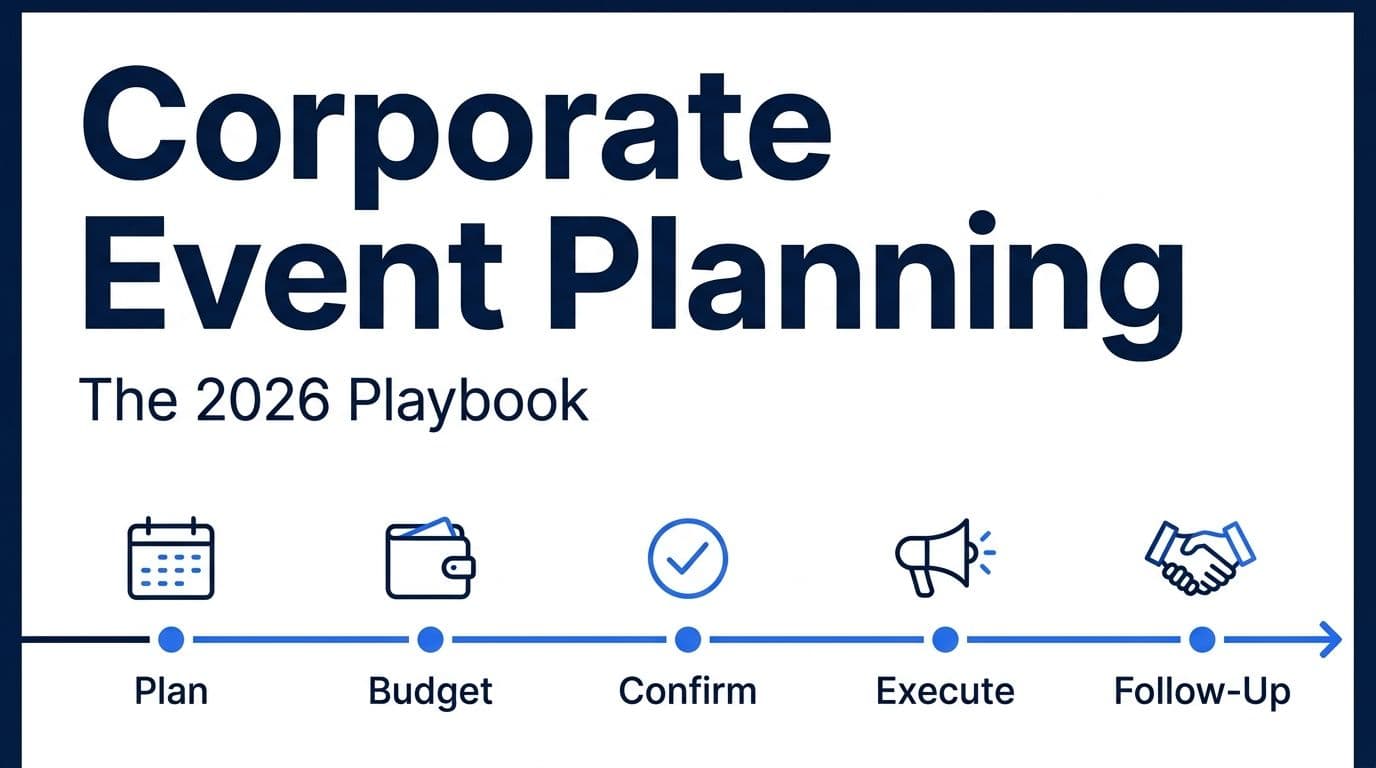
Most corporate event planning guides read like checklists written for events that already worked. This one is built around the actual failure points — the moments where events lose attendance, engagement, or budget — and what changed in 2026 that fixes them.
If you're planning a corporate conference, product launch, sales kickoff, or company offsite, this is the playbook: timeline, budget, attendance confirmation, engagement, and the AI tools that have moved from experimental to standard over the past year.
The 2026 corporate event planning timeline
For a mid-size corporate event (100-500 attendees), plan on 12-16 weeks of lead time. Compress it, and you'll spend the final two weeks firefighting instead of executing. The phases break down like this:
Weeks 1-4 — Foundation: Define objectives, lock budget, book venue and key vendors, and confirm date against competing events on your audience's calendar.
Weeks 4-8 — Build: Open registration, launch marketing, finalize agenda and speakers, set up your attendee communication stack.
Weeks 8-12 — Fill the room: This is where most teams under-invest. Registration numbers look healthy, but the gap between "registered" and "will actually show up" is where events quietly lose momentum. See our full breakdown of where events lose momentum and teams don't notice.
Weeks 12-16 — Confirm and execute: Attendance confirmation, logistics finalization, day-of staffing, and the event itself, followed by a structured post-event sequence.
Larger conferences (1,000+ attendees) need 6-12 months, mostly for venue sourcing and speaker coordination — but the final-mile confirmation window stays roughly the same length regardless of event size.
Budgeting for a corporate event in 2026
Budget allocation has shifted meaningfully over the past two years. Venue and catering still consume 40-50% of most mid-size event budgets, but the remaining allocation looks different from what it did pre-2025.
Physical swag and branded merchandise budgets are shrinking. Communication infrastructure budgets are growing — teams are increasingly willing to pay for voice AI confirmation calls, AI chat support, and SMS reminder systems because the ROI is directly measurable against attendance numbers, unlike a branded tote bag.
The practical framework: allocate your budget against the attendance lifecycle, not against event-day aesthetics alone. A dollar spent confirming that a registrant actually shows up is worth more than a dollar spent on a nicer step-and-repeat banner, because the real cost of a no-show compounds across catering, staffing, and sponsor obligations you've already committed to.
Why attendance confirmation is the most under-planned phase
Here's the pattern across most corporate events: registration gets significant planning attention (marketing calendar, landing page, promo emails), and attendance confirmation gets almost none — usually just a calendar invite and maybe a reminder email three days out.
That's backwards. Email open rates for event reminders are notoriously unreliable, and a reminder that's never opened does nothing for your no-show rate. The events that consistently hit their attendance targets treat confirmation as its own planning phase with its own budget and owner, not an afterthought bolted onto marketing.
PERSONAL EXPERIENCE --> In our work with event teams building out this phase, the pattern is consistent: teams that add a voice confirmation call 7-10 days before the event, followed by an SMS reminder 24-48 hours out, see meaningfully higher show-up rates than teams relying on email alone. Voice reaches a dramatically higher share of registrants than email ever does, because a phone call — even an AI-driven one — gets picked up or returned in a way an unopened email never will.
For the specific tactics that make this work, see our full list of event engagement ideas organized by pre-event, day-of, and post-event stage.
Day-of execution: what actually needs a human
AI has taken over a meaningful share of day-of-event operations, but not all of it — and knowing the line matters. AI chat agents are well-suited to answering repetitive logistics questions (where's registration, what's the WiFi password, when does the keynote start) that would otherwise flood your ops team's inbox in the final hour before doors open.
What still needs a human: relationship management with VIP attendees and sponsors, real-time problem-solving when something breaks (AV failure, catering delay), and any moment where the interaction is really about the relationship, not the information. The best-run corporate events in 2026 use AI to absorb the volume of routine questions specifically so their human team has bandwidth for the moments that require judgment.
This is the core argument behind why event teams need agentic AI, not just assistive AI — the goal isn't replacing your ops team, it's freeing them from repetitive work so they can handle what actually requires a person.
Post-event follow-up: the phase most events skip entirely
The 72-hour window after a corporate event is where the most durable ROI gets created or lost. A thank-you touchpoint within 4 hours, a feedback ask at 24 hours (response rates drop sharply after this window), and a re-engagement or next-steps nudge at 72 hours consistently outperforms a single "thanks for coming" email sent a week later.
For sales kickoffs and customer events specifically, this window is also where pipeline influence gets captured — attendees are still primed by the event content, and a well-timed follow-up converts that attention into a next step. Wait a week, and that window closes.
The corporate event tech stack in 2026
A typical corporate event tech stack now has three layers. The core platform (Cvent, Bizzabo, Whova, or similar) handles registration, agenda, and the attendee-facing app. The communication layer (voice, chat, SMS — this is where KATHN operates) handles the attendee lifecycle: confirmation, reminders, day-of support, and follow-up. The CRM layer (Salesforce, HubSpot) connects event data to broader marketing and sales systems so attendance and engagement data doesn't die in a spreadsheet after the event ends.
UNIQUE INSIGHT --> The teams getting the best results in 2026 aren't the ones with the most tools — they're the ones who've stopped treating registration, confirmation, and follow-up as three separate systems owned by three different people. When one team owns the full attendee lifecycle, the handoffs that usually cause attendance to leak simply don't happen.
Measuring success beyond registration count
Registration count is the easiest number to report and the least useful one on its own. A corporate event with 500 registrations and a 60% show-up rate delivered fewer engaged attendees than one with 350 registrations and an 85% show-up rate — but only the second team can say with confidence who actually walked in the room.
The metrics worth tracking across the full lifecycle: registration-to-attendance conversion rate, day-of engagement (session attendance, app activity, networking participation), post-event feedback response rate, and for revenue-driving events, downstream pipeline or re-registration influence. We cover this in more depth in measuring what matters, from registration to real attendance.
A practical 2026 corporate event planning checklist
- 12-16 weeks out: Lock objectives, budget, venue, and date
- 8-12 weeks out: Open registration, launch marketing, finalize agenda
- 4-6 weeks out: Set up your communication stack — confirm who owns voice, chat, and SMS workflows
- 2-3 weeks out: Begin attendance confirmation calls and reminder sequences
- 48 hours out: Final SMS reminder, logistics packet, day-of staffing confirmed
- Day of: AI chat live for inbound questions, human team focused on relationship moments and problem-solving
- 4 hours post-event: Thank-you touchpoint sent
- 24 hours post-event: Feedback ask sent
- 72 hours post-event: Re-engagement or next-steps nudge sent
Where this is heading
Corporate event planning in 2026 is converging on the same underlying idea across every event size: the events that perform best treat the attendee lifecycle as one connected system, not a series of disconnected tasks handed off between marketing, ops, and sales. AI has made the communication layer of that system — confirmation, reminders, day-of support, follow-up — cheap and fast enough to run at scale for the first time.
The teams that adopt this early aren't necessarily running bigger events. They're running events where more of the people who registered actually show up, engage, and come back next year.
This post is part of KNVI Labs' series on event technology and attendee lifecycle management.
Related reading: The Complete Guide to Event Attendee Lifecycle Management · 21 Event Engagement Ideas That Actually Work in 2026
Frequently Asked Questions
How far in advance should you plan a corporate event?
For a mid-size corporate event (100-500 attendees), plan 12-16 weeks in advance. This allows 4-6 weeks for venue and vendor booking, 4-6 weeks for marketing and registration, and a critical final 2-3 weeks for attendance confirmation and logistics. Larger conferences with 1,000+ attendees typically need 6-12 months of lead time.
What is the average budget for a corporate event?
Corporate event budgets vary widely by scale and format, but a common mid-size in-person event (200-300 attendees, single day) typically runs from the low tens of thousands to over $100,000 depending on venue, catering, and production quality. Venue and catering usually consume 40-50% of the total budget, with the remainder split across marketing, staffing, and technology.
What are the biggest mistakes in corporate event planning?
The most common corporate event planning mistakes are under-investing in attendance confirmation (relying on email alone), treating registration count as the success metric instead of confirmed attendance, skipping a structured post-event follow-up sequence, and failing to build in contingency time for the final two weeks before the event when most operational issues surface.
What software do corporate event planners use in 2026?
Corporate event planners in 2026 typically use a combination of a core event management platform (Cvent, Bizzabo, Whova, or similar) for registration and agenda management, plus a dedicated AI communication layer like KATHN for voice, chat, and SMS across the attendee lifecycle. Many teams also use CRM integrations (Salesforce, HubSpot) to connect event data to broader marketing and sales workflows.
How do you measure the success of a corporate event?
Corporate event success is best measured across the full attendance lifecycle, not just registration count. Key metrics include the registration-to-attendance conversion rate, day-of engagement (session attendance, app or platform activity), post-event feedback response rate, and downstream metrics like pipeline influence or re-registration for future events.
Hemal Shah is the Co-Founder of KNVI Labs. Hemal works alongside event organizers, PCOs, and event-tech companies on AI strategy, and co-built KATHN — the AI communication platform that runs voice, chat, and SMS across the attendee lifecycle. Hemal writes about event operations, AI for events, and the patterns behind events that fill the room.
Run one event with KATHN. See the difference.
Voice, SMS, and chat agents across your full event lifecycle — pre-event, day-of, and post-event. Pilots launch in 5 days with zero technical lift.